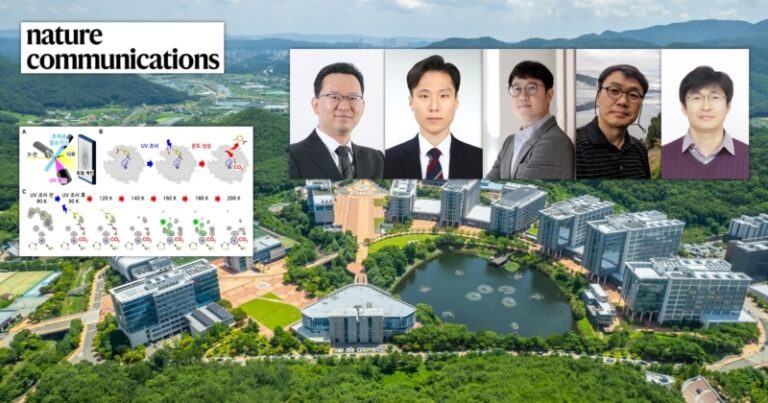
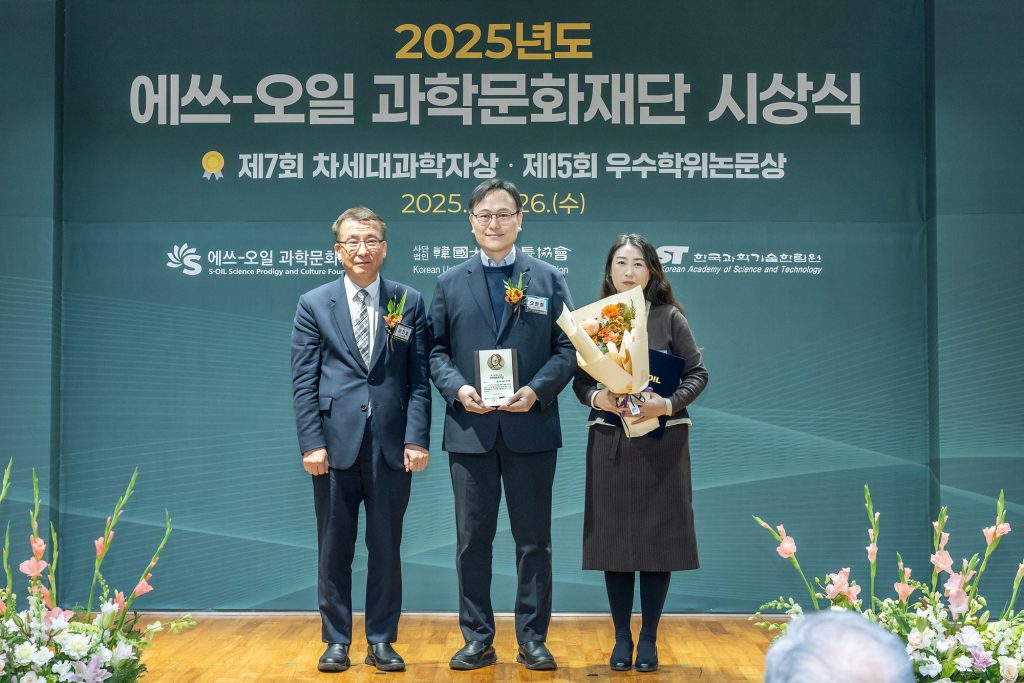
UNIST Department of Chemistry earned two major honors at the 2025 S-Oil Science and Culture Foundation Awards Ceremony, with Professor Hyunchul Oh and Dr. Joohan Nam recognized in both the ‘Next-Generation Scientist’ and ‘Outstanding Dissertation’ categories, respectively. The awards acknowledge sustained contributions to fundamental chemical research and hydrogen-related science.
“ Professor Hyunchul Oh Presents High-Density
Physical Adsorption and Quantum-based
Isotope Separation Mechanisms
Professor Hyunchul Oh was selected as a recipient of the 7th S-OIL Next-Generation Scientist Award in chemistry. The award, supported by the S-OIL Science and Culture Foundation and administered by the Korean Academy of Science and Technology (KAST), is presented to early-career researchers under the age of 45 based on an overall assessment of their research achievements over the past decade. Only one researcher is selected annually in each of six areas spanning basic science and engineering.
Professor Oh’s research focuses on the physical adsorption of hydrogen within nanoporous solids. His work has demonstrated that specific pore environments can enable hydrogen to be stored at exceptionally high densities. In particular, a study published in Nature Chemistry reported experimental evidence that a hydridic small-pore structure can achieve storage densities approaching twice that of liquid hydrogen.
These findings have been noted for their potential relevance to hydrogen carrier design and storage efficiency, with possible implications for reducing infrastructure requirements over the long term.
Professor Oh has also contributed to isotope separation research by experimentally establishing a quantum-selective adsorption mechanism under cryogenic conditions. His studies identified an additional adsorption site that selectively interacts with deuterium and demonstrated a diffusion inversion effect in flexible metal–organic frameworks (MOFs), in which heavier isotopes exhibit faster diffusion. This work suggests alternative approaches to isotope separation that may reduce reliance on energy-intensive cryogenic distillation.
In parallel with his research, Professor Oh is active in international collaboration. He serves as Korea’s representative and an executive committee member of the IEA Hydrogen Technology Collaboration Programme (H₂TCP) and holds professional roles within the Korean Hydrogen and New Energy Society and the Korean Chemical Society. He also serves as an Associate Editor of Heliyon.
“This recognition reflects the collective efforts of the students and colleagues involved in our research,” Professor Oh said. “I hope to continue work that contributes meaningfully to carbon neutrality and energy transition.”
“ Dr. Joohan Nam Expands the Concept of
‘Smart Solid’ … Publishing 3 Consecutive
Papers in Angewandte Chemie
Dr. Joohan Nam received the 15th S-Oil Outstanding Dissertation Award (Ph.D. category) for his doctoral research in chemistry. The award is presented annually to doctoral theses evaluated for originality, completeness, and scientific impact.
Dr. Nam’s research examined molecular-scale motions—such as rotation and folding—within zeolitic imidazolate frameworks (ZIFs). Through quantitative analysis, he proposed a framework for interpreting these materials as dynamic systems, in which internal molecular motion contributes to functional behavior.
He extended this approach to hydrogen isotope separation, establishing quantitative relationships between structural dynamics and separation performance. The coherence of this research has been recognized through the consecutive publication of three first-author papers in Angewandte Chemie (2024 June, 2024 November, and 2025 January).
The work has drawn attention amid renewed global interest in metal–organic frameworks, with researchers noting its systematic treatment of dynamic behavior in porous solids.
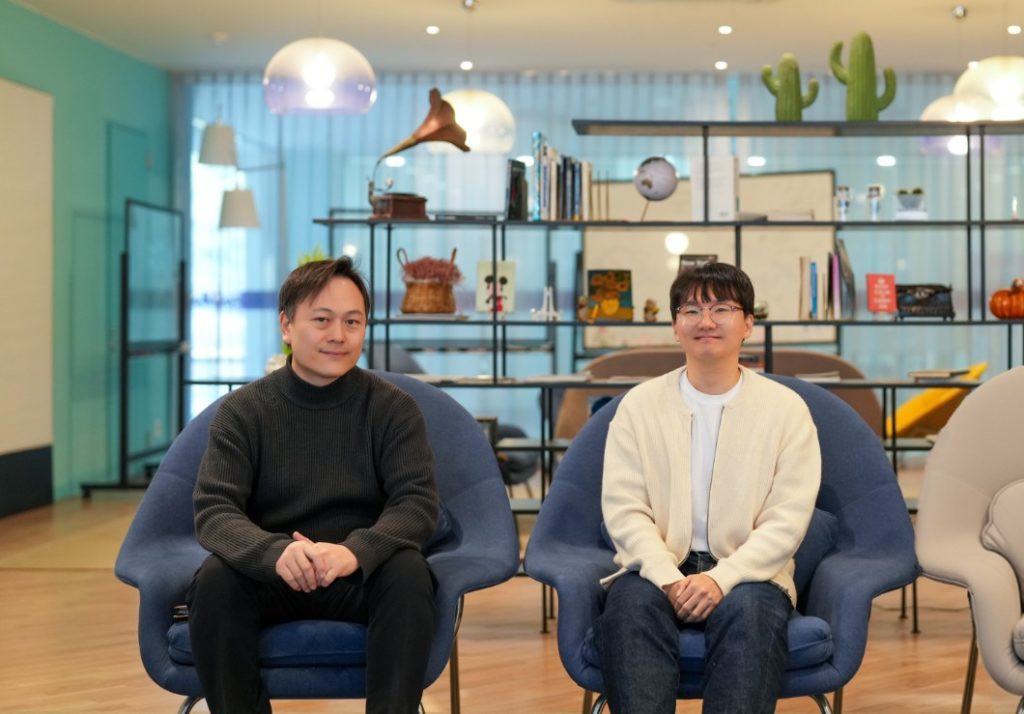
“I am grateful that this work has been carefully evaluated and recognized,” said Dr. Nam. “I aim to continue research that connects structure and function in the design of new materials.”
Dr. Nam has also received the Outstanding Doctoral Dissertation Award from the Korean Chemical Society (2025) and the Young Investigator Award from the Korean Synchrotron Users Association (2025). He is currently conducting international collaborative research at TU Dresden in Germany with support from the National Research Foundation of Korea and UNIST.